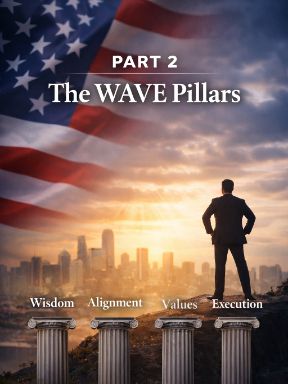
WAVE Pillars
The WAVE pillars, Wisdom, Alignment, Values, and Execution, define the core structure of responsible leadership. They represent the progression from thoughtful insight to coordinated action, guiding leaders to make decisions that balance perspective, integrity, and results. Throughout Leadership250, these pillars help
Wisdom

The First Pillar of Leadership
Wisdom is the foundation of leadership. Before decisions are made, strategies developed, or actions taken, effective leaders step back to understand the broader context in which they operate.
Wisdom requires perspective. It means seeing beyond immediate pressures to consider long-term consequences, historical lessons, and the people affected by decisions.
Across history, moments of transformational leadership often began with reflection before action. Leaders who demonstrate wisdom recognize that leadership is not only about authority or speed, but about understanding complexity and choosing the right path forward.
Within the WAVE leadership framework, Wisdom represents the starting point for responsible leadership.
Why Wisdom Matters in Leadership
Leaders face uncertainty, competing priorities, and incomplete information. Wisdom allows leaders to interpret these challenges thoughtfully rather than react impulsively.
Wise leaders:
• seek diverse perspectives
• study lessons from history
• understand long-term consequences
• balance action with reflection
Wisdom helps leaders navigate difficult decisions while maintaining clarity of purpose and responsibility.
Wisdom in Historical Leadership
The Leadership250 project explores moments in American history where wisdom shaped pivotal decisions.
Examples include:
Declaration of Independence (1776)
Leaders carefully considered the risks and consequences of declaring independence before committing to a path that would change the course of history.
Lincoln at Gettysburg (1863)
In the midst of national conflict, Lincoln reframed the purpose of the Civil War, offering a vision that restored meaning and unity to a divided nation.
These moments demonstrate how wisdom helps leaders see beyond immediate crises to define long-term direction.
Wisdom in the WAVE Framework
In the WAVE leadership model, Wisdom is the first pillar supporting effective leadership.
Wisdom informs:
• Alignment of teams and institutions
• Values that guide decision-making
• Execution of strategic initiatives
Without wisdom, leadership risks becoming reactive rather than purposeful.
Wisdom and Modern Leadership
Although the environments leaders operate in today are more complex and interconnected, the need for wisdom remains constant.
Modern leaders face challenges that require thoughtful judgment:
• emerging technologies
• global economic shifts
• institutional trust
• long-term societal impact
Wisdom enables leaders to balance innovation with responsibility and short-term decisions with long-term consequences.
Leadership250 and Wisdom
Leadership250 connects historical leadership moments to enduring leadership principles such as Wisdom.
Each weekly leadership reflection explores how leaders throughout history demonstrated insight, perspective, and judgment in moments that shaped the future.
Through these examples, Leadership250 highlights how wisdom remains essential for leadership in every era.
Learn More
The Wisdom leadership principle is part of the WAVE + ONS leadership framework, explored in greater depth in the book:
Leadership with American Innovation
This framework connects historical leadership lessons with practical guidance for modern leaders.
Alignment

The Second Pillar of Leadership
Alignment ensures that people, organizations, and resources move toward a shared purpose. While wisdom provides perspective, alignment transforms that perspective into coordinated action.
Effective leaders recognize that success rarely comes from individual effort alone. Progress requires individuals, teams, and institutions working together toward a common objective.
Within the WAVE leadership framework, Alignment represents the discipline of bringing people together around clear goals and shared direction.
Why Alignment Matters in Leadership
Even the best ideas cannot succeed without coordination and commitment. Alignment allows leaders to bring clarity to complex environments by ensuring that everyone understands the mission and their role within it.
Aligned organizations benefit from:
• shared purpose and direction
• clear communication across teams
• coordinated decision-making
• stronger collaboration and trust
When leaders create alignment, they reduce confusion, strengthen unity, and enable people to work together more effectively.
Alignment in Historical Leadership
Throughout history, some of the most significant leadership achievements required alignment across diverse groups and competing interests.
Examples include:
The Alliance at Yorktown (1781)
The American victory at Yorktown depended on alignment between American and French forces. Strategic coordination between Washington and allied leaders brought together resources, strategy, and timing to achieve a decisive outcome.
Apollo 11 Mission (1969)
Landing humans on the Moon required extraordinary alignment across scientists, engineers, government leaders, and thousands of individuals working toward a shared national objective.
These examples demonstrate how alignment enables large-scale achievements that no single leader or organization could accomplish alone.
Alignment in the WAVE Framework
Within the WAVE leadership model, Alignment connects wisdom to action.
Alignment helps leaders:
• translate vision into coordinated effort
• bring teams and institutions together
• ensure strategies are understood and supported
• maintain focus on shared objectives
Without alignment, even wise decisions and strong values can fail to produce meaningful results.
Alignment and Modern Leadership
Modern leadership environments are increasingly complex, requiring collaboration across organizations, sectors, and disciplines.
Today’s leaders must align:
• diverse teams and perspectives
• technology and human capability
• institutional goals and public trust
• innovation with responsible governance
Alignment enables leaders to coordinate these forces and move forward with unity and purpose.
Leadership250 and Alignment
Leadership250 explores moments in history where leaders successfully aligned people, ideas, and resources to achieve extraordinary outcomes.
By examining these historical examples, the project highlights how alignment remains essential for leadership in every era.
Learn More
The Wisdom leadership principle is part of the WAVE + ONS leadership framework, explored in greater depth in the book:
Leadership with American Innovation
This framework connects historical leadership lessons with practical guidance for modern leaders.
Values

The Third Pillar of Leadership
Values provide the ethical foundation for leadership. While wisdom brings perspective and alignment brings people together, values guide how leaders make decisions and how those decisions affect others.
Effective leadership requires more than strategy or coordination. It requires a clear understanding of the principles that define what is right, responsible, and worthy of pursuit.
Within the WAVE leadership framework, Values represent the moral compass that helps leaders navigate difficult choices and maintain integrity in the face of pressure.
Why Values Matters in Leadership
Leaders frequently face situations where the right decision is not the easiest one. Values help leaders remain grounded in purpose and responsibility when navigating complex challenges.
Leaders guided by strong values demonstrate:
• integrity in decision-making
• consistency between words and actions
• respect for people and institutions
• commitment to principles beyond personal gain
Values build trust. When leaders act consistently with their values, they create credibility and stability for the people and organizations they lead.
Values in Historical Leadership
Throughout history, leadership decisions have often been shaped by the values leaders chose to uphold.
Examples include:
The Gettysburg Address (1863)
In the midst of the Civil War, Abraham Lincoln reframed the purpose of the conflict around the principle that all people are created equal. His message reaffirmed the values upon which the nation was founded.
The Civil Rights Movement (1950s–1960s)
Leaders of the civil rights movement demonstrated a commitment to justice and equality, challenging institutions and society to live up to the nation’s founding values.
These moments show how values can guide leadership decisions that shape the course of history.
Values in the WAVE Framework
Within the WAVE leadership model, Values ensure that leadership decisions are grounded in ethical responsibility.
Values help leaders:
• establish trust within organizations
• guide difficult decisions during uncertainty
• balance authority with accountability
• maintain legitimacy and credibility
Without values, leadership risks becoming purely transactional or self-serving rather than principled and responsible.
Values and Modern Leadership
Modern leaders operate in environments where trust, transparency, and accountability are increasingly important.
Leaders today must navigate challenges involving:
• ethical use of emerging technologies
• institutional trust and governance
• fairness and responsibility in decision-making
• long-term societal impact
Values help leaders ensure that progress and innovation remain aligned with ethical responsibility.
Leadership250 and Values
Leadership250 highlights moments in history where leaders demonstrated courage and clarity by acting according to their values.
These historical examples remind us that leadership is not only about achieving results, but about doing so in ways that uphold principles and strengthen the institutions and communities we serve.
Learn More
The Wisdom leadership principle is part of the WAVE + ONS leadership framework, explored in greater depth in the book:
Leadership with American Innovation
This framework connects historical leadership lessons with practical guidance for modern leaders.
Execution
The Forth Pillar of Leadership
Execution transforms ideas into results. While wisdom provides perspective, alignment brings people together, and values guide decisions, execution ensures that leadership produces meaningful outcomes.
Leadership ultimately requires action. Plans, strategies, and intentions must be translated into disciplined effort and coordinated implementation.
Within the WAVE leadership framework, Execution represents the ability to move from vision to reality.
Why Execution Matters in Leadership
Effective leaders understand that success depends not only on strategy but also on the ability to implement that strategy consistently and effectively.
Strong execution requires:
• clear goals and priorities
• disciplined planning and coordination
• accountability for results
• persistence through obstacles
Execution bridges the gap between aspiration and achievement.
Execution in Historical Leadership
Some of the most remarkable leadership achievements in history required extraordinary execution.
Examples include:
D-Day Invasion (1944)
The success of the Allied invasion of Normandy required extensive coordination across military forces, logistics, intelligence, and timing. Careful planning and disciplined execution were essential to the mission’s success.
Apollo 11 Mission (1969)
Landing humans on the Moon was the result of years of planning, engineering innovation, and precise execution by thousands of scientists, engineers, and mission specialists.
These examples illustrate how effective execution turns ambitious goals into historic accomplishments.
Execution in the WAVE Framework
Within the WAVE leadership model, Execution represents the final pillar that brings leadership strategy to life.
Execution enables leaders to:
• translate vision into operational plans
• coordinate teams and resources effectively
• maintain focus on mission objectives
• deliver meaningful and measurable results
Without execution, even the strongest leadership ideas remain unrealized.
Execution and Modern Leadership
Modern leadership environments demand disciplined execution across increasingly complex systems.
Leaders today must execute initiatives involving:
• technological innovation
• institutional transformation
• global collaboration
• long-term strategic investments
Execution ensures that leadership initiatives produce tangible progress rather than remaining theoretical ambitions.
Leadership250 and Execution
Leadership250 highlights moments where leaders successfully executed bold ideas and complex strategies.
These historical examples demonstrate how disciplined implementation allows leaders to turn vision into lasting impact.
Learn More
The Wisdom leadership principle is part of the WAVE + ONS leadership framework, explored in greater depth in the book:
Leadership with American Innovation
This framework connects historical leadership lessons with practical guidance for modern leaders.